
DACTYLORHIZA IBERICA
Family and Genus:- See- ORCHIDACEAE
Common Name:- Georgian dactylorhiza
Homotypic Synonyms:- Dactylorchis iberica, Orchis iberica
Meaning:- Dactylorhiza (Gr) With finger-like roots.
Iberica (L) dedicated to lberia (lberica), an old region of Eastern
Georgia and not to the Iberian Peninsula,
General description:- Robust perennial terrestrial orchid
Stem:-
1) 20-60 cm, erect, hollow, green to purplish, often spotted near the base.
Leaves:-
1) 4-8, lanceolate to oblong-lanceolate, 6-20 × 1-3 cm, sheathed at the base.
a) upper, gradually smaller and bract-like.
2) Foliage, often spotted with dark purplish dots, particularly on the lower leaves,
margins entire, apex acute.
Flowers:-
1) Large, 15-25 mm across, pink to purplish, rarely pale lilac.
2) Inflorescence, dense to a loose, many-flowered cylindrical spike, 5-15 cm long.
3) Bracts, lanceolate, green or purplish, often exceeding the flowers.
4) Labellum 3-lobed,
a) middle, slightly notched, marked with darker purple spots and loops; spur
cylindrical, curved downward, about as long as the ovary.
5) Sepals and petals, forming a hood over the column;
a) lateral sepals, spreading or slightly recurved.
Fruit:-
1) Capsule, erect, ellipsoid, 10-12 mm long, containing numerous minute dust-like
seeds
Key features:-
Habitat:- Wet mountain meadows, spring-fed slopes, stream margins, and
subalpine grasslands, often on calcareous soils, 1 000-2 400 m. Prefers cool, moist
habitats in open light or partial shade.
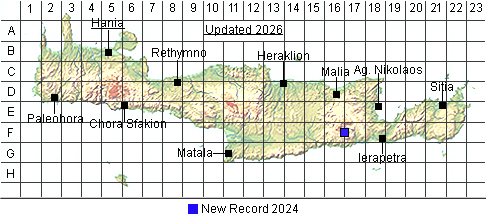
Distribution:- Native to: Cyprus, Greece, Iran, Krym, Lebanon, Syria, North
Caucasus, Palestine, Transcaucasus. Previously unrecorded from Crete.
Discovered by Zacharias Angourakis, Dorothea Hege near Selakano in June 2024.
Flowering time:- From April to June; fruits develop from June to August.
Photos by:- Zacharias Angourakis, Dorothea Hege
SPECIES DESCRIPTION